Archaeological and archaeobotanical expedition in Gabon
Archaeological and archaeobotanical expedition in Gabon: understanding the human history of the forests of the Congo Basin
From 05 Feb. 2026 to 10 Mar. 2026
Gabon
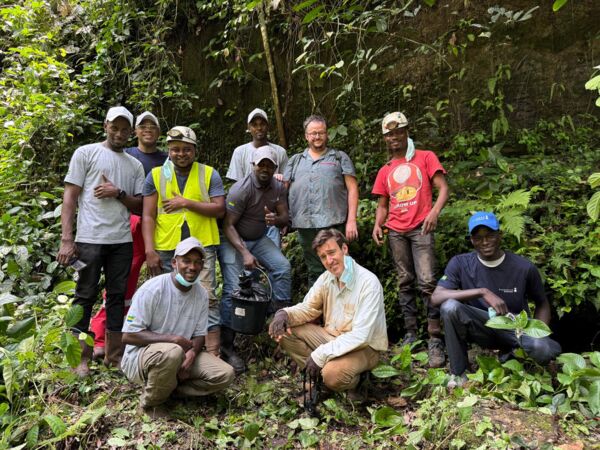
From 5 February to 10 March 2026, a research mission took place in Gabon as part of the ANR Rainforstory project, in conjunction with the One Forest Vision (OFVi) initiative. This mission, led in particular by Louis Champion (IRD) and Geoffroy De Saulieux (IRD), archaeologist and coordinator of the RACINES project, illustrates the gradual integration of the humanities and social sciences (HSS) within OFVi.
The aim is to gain a better long-term understanding of the relationship between human societies and tropical forests in the Congo Basin. Today’s forest landscapes are not merely the result of natural processes; they also bear the marks of ancient human practices, such as gathering, agriculture, land management and arboriculture.
Analysing archaeological and archaeobotanical remains
This expedition combined archaeology, archaeobotany and environmental analysis to explore these interactions between human societies and forest ecosystems.
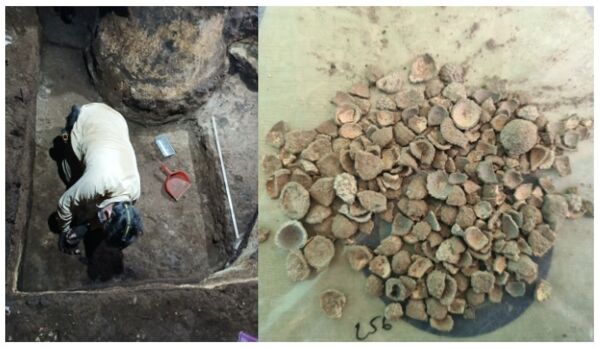
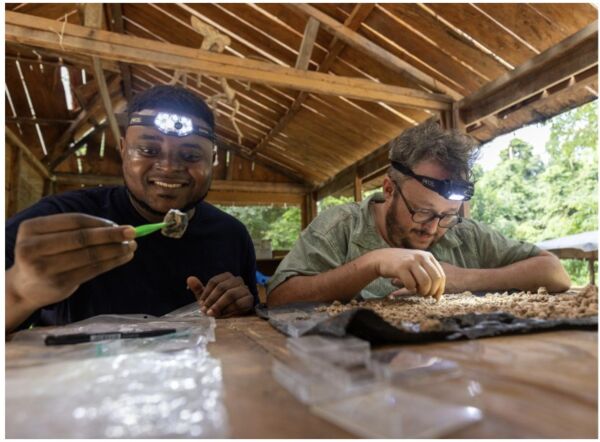
The initial phase of the work was devoted to processing archaeological material from around ten sites excavated during previous campaigns. Over a period of about two and a half weeks, the researchers sorted through the residues resulting from the sifting of archaeological sediments.
These residues were analysed to identify the different categories of remains present, including lithic fragments, ceramic fragments, archaeozoological remains, as well as archaeobotanical remains and various small artefacts. Each category was recorded according to the archaeological context and stratigraphic levels, enabling a better understanding of the distribution of the material within the sites studied.
Particular attention was paid to plant remains. These were counted and, where possible, identified to species level. Certain remains were also selected for further analysis. Canarium fruits, for example, were measured as part of morphometric analyses designed to study changes in their morphology over time. Fragments of Celtis sp. were isolated for future isotopic and palaeoclimatic analyses, to be conducted in particular by researchers from the IRD, in order to reconstruct the evolution of environmental parameters such as rainfall and temperature.
Archaeobotanical flotation: revealing ancient plant remains
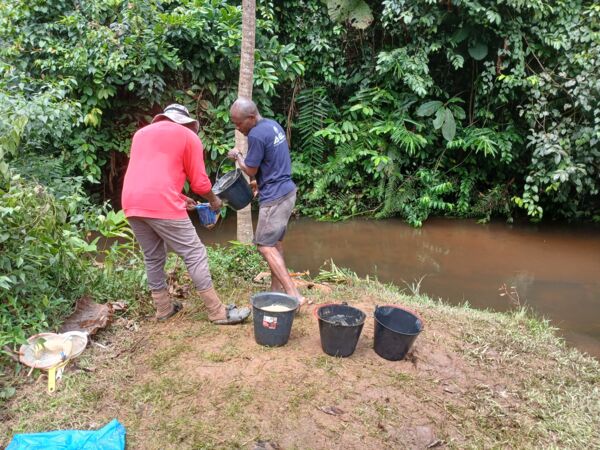
The mission also provided an opportunity to carry out an archaeobotanical flotation campaign on sediments from excavations conducted in 2024 and 2025. This technique involves using water to separate the various components of archaeological sediments.
Flotation yields two main fractions: a light fraction, consisting mainly of charred plant remains, and a heavy fraction comprising mineral and archaeological residues. The residues obtained were then sorted using the same methodology as that applied to the screen rejectings.
The analysis of these plant remains provides a valuable source of information for reconstructing the history of plant use, ancient agricultural practices and the evolution of forest landscapes.
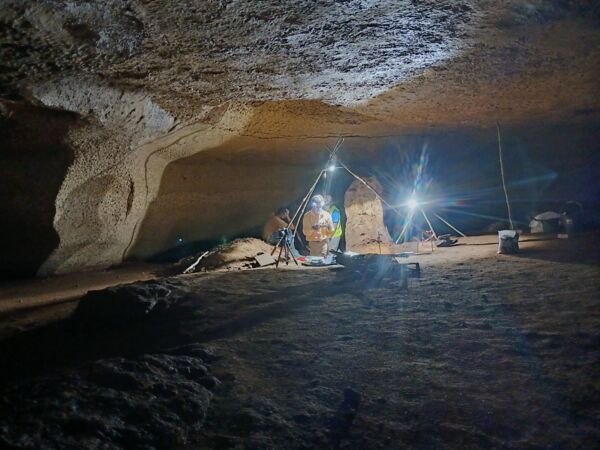
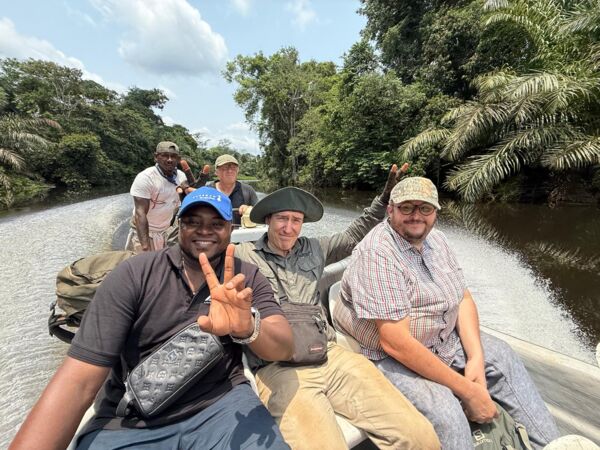
An excavation campaign lasting around ten days was carried out in the Abanda region, in the province of Ogooué-Maritime, at the Grotte du Menhir site. This project forms part of the ongoing archaeological research already underway in the region in collaboration with the Liambissi Foundation and the 2SRO camp.
During this excavation, 19 archaeobotanical samples were collected, each sample representing approximately ten litres of sediment. The sediments were processed directly in the field using flotation and wet sieving techniques, and then sorted into different archaeological categories.
Initial results indicate the presence of oil palm (Elaeis guineensis) remains in all the samples analysed. This finding suggests that this plant resource was regularly exploited by ancient populations and provides new insights into the history of interactions between human societies and forest plants.
The mission also included a significant component focused on training and skills transfer. A Gabonese archaeologist from the National Parks Agency (ANPN), Drile Arnauld Mamfoumbi Mamfoumbi, received ongoing training in field archaeobotany throughout the mission.
This training covered several key methodological aspects, including the basic principles of archaeobotany applied to tropical contexts, sediment sampling methods, techniques for processing sediments in the field, as well as procedures for flotation, sieving and identification of plant macroremains.
This work contributes to strengthening local scientific expertise in a discipline that is still under-represented in Central Africa.
The mission also gave rise to several public outreach initiatives aimed at sharing the research findings with a wider audience.
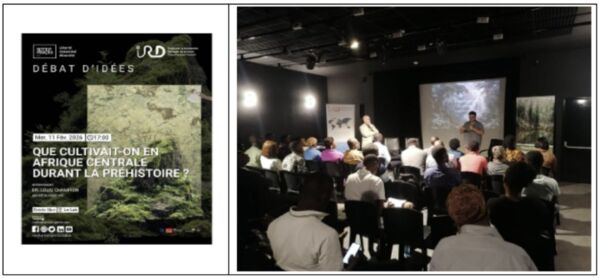
On 12 February 2026, a lecture entitled ‘What was cultivated in Central Africa during prehistory?’ was held at the French Institute of Gabon as part of the lecture series ‘Discovering Gabon’s Prehistory’. Lasting one and a half hours, this lecture attracted around 70 participants and provided an opportunity to present archaeobotanical methods, recent findings on plant use in Central Africa, and research prospects regarding the history of agriculture in tropical forests.
On 8 March 2026, a more specialised presentation on the oil palm (Elaeis guineensis) in the archaeology of Central Africa was also delivered in collaboration with Geoffroy de Saulieu (IRD) for the French association Les Fous du Palmier.
Understanding the past to better shape the future of our forests
A number of further analyses are now planned, including detailed sorting of the light fractions under a microscope, radiocarbon (C14) dating, additional morphometric analyses, and isotopic and palaeoclimatic analyses of certain plant remains.
This work will provide new data on the history of plant resource use, the interactions between human societies and the forest environment, and past climatic dynamics in Central Africa.
By integrating the humanities and social sciences with environmental and ecological approaches, One Forest Vision thus contributes to a better understanding of the complex relationships between societies, forests and the economy in the Congo Basin. Understanding these legacies over the long term is essential for developing strategies for the sustainable management of tropical forests, adapted both to ecological realities and to the societies living there.
This mission was carried out with the support and collaboration of ANR Rainforstory, the One Forest Vision Initiative (OFVi), IRD, the Liambissi Foundation, ANPN, and CENAREST.
By browsing our site you accept the installation and use cookies on your computer.
Know more
Our use of cookies
Cookies are a set of data stored on a user’s device when the user browses a web site. The data is in a file containing an ID number, the name of the server which deposited it and, in some cases, an expiry date. We use cookies to record information about your visit, language of preference, and other parameters on the site in order to optimise your next visit and make the site even more useful to you.
To improve your experience, we use cookies to store certain browsing information and provide secure navigation, and to collect statistics with a view to improve the site’s features. For a complete list of the cookies we use, download “Ghostery”, a free plug-in for browsers which can detect, and, in some cases, block cookies.
You can also visit the CNIL web site for instructions on how to configure your browser to manage cookie storage on your device.
In the case of third-party advertising cookies, you can also visit the following site: https://www.youronlinechoices.com/fr/controler-ses-cookies/, offered by digital advertising professionals within the European Digital Advertising Alliance (EDAA). From the site, you can deny or accept the cookies used by advertising professionals who are members.
It is also possible to block certain third-party cookies directly via publishers:
Cookie type
Means of blocking
Analytical and performance cookies
Realytics Google Analytics Spoteffects Optimizely
Targeted advertising cookies
DoubleClick Mediarithmics
The following types of cookies may be used on our websites:
Mandatory cookies
Functional cookies
Social media and advertising cookies
These cookies are needed to ensure the proper functioning of the site and cannot be disabled. They help ensure a secure connection and the basic availability of our website.
These cookies allow us to analyse site use in order to measure and optimise performance. They allow us to store your sign-in information and display the different components of our website in a more coherent way.
These cookies are used by advertising agencies such as Google and by social media sites such as LinkedIn and Facebook. Among other things, they allow pages to be shared on social media, the posting of comments, and the publication (on our site or elsewhere) of ads that reflect your centres of interest.
Our EZPublish content management system (CMS) uses CAS and PHP session cookies and the New Relic cookie for monitoring purposes (IP, response times). These cookies are deleted at the end of the browsing session (when you log off or close your browser window)
Our EZPublish content management system (CMS) uses the XiTi cookie to measure traffic. Our service provider is AT Internet. This company stores data (IPs, date and time of access, length of the visit and pages viewed) for six months
Our EZPublish content management system (CMS) does not use this type of cookie.
For more information about the cookies we use, contact INRAE’s Data Protection Officer by email at cil-dpo@inra.fr or by post at:
INRAE 24, chemin de Borde Rouge –Auzeville – CS52627 31326 Castanet Tolosan cedex - France