Understanding the growth of tropical forests: 2nd scientific expedition to the Mbalmayo super-site
From 02 Mar. 2026 to 09 Mar. 2026
Mbalmayo – Cameroon
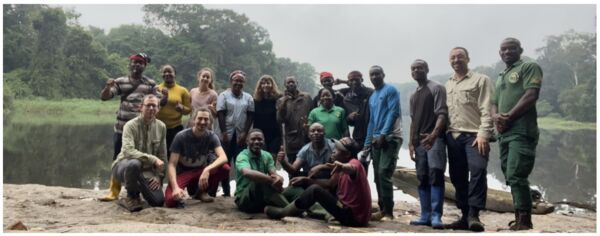
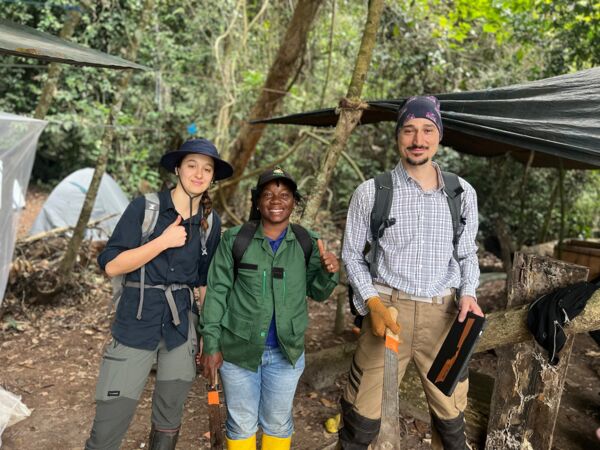
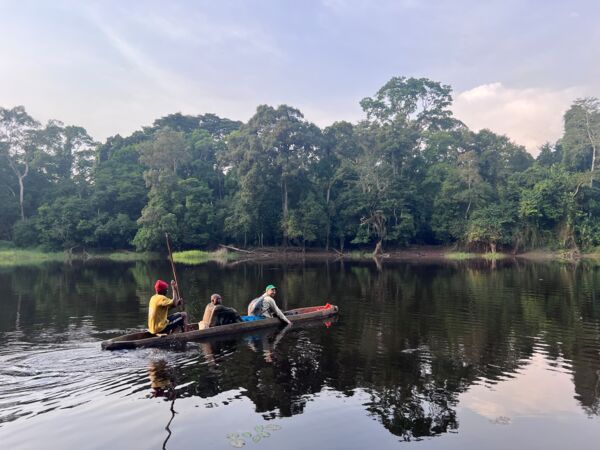
In March 2026, a team from the AMAP laboratory (University of Montpellier, IRD, CIRAD, INRAE, CNRS), supported by the One Forest Vision initiative and the European Biodiversa+ Coforfunc project, and with the backing of the IRD’s Central African office, conducted a two-week scientific mission to the Mbalmayo forest super-site, situated on the banks of the Nyong River in Cameroon. This site, situated in a forest reserve near Yaoundé, is one of the main study sites for tropical forests in Central Africa. It is particularly valuable as it combines long-term ecological monitoring (permanent forest inventory plots), drone observations and detailed ecophysiological measurements of trees.
Translated with DeepL.com (free version)
1. Understanding tree growth and carbon sequestration
Beyond the objectives of the GeoTrees component of the OFV Initiative—to improve carbon stock estimates using LiDAR—one of the original aims of this mission was to gain a better understanding of the growth mechanisms of tropical trees and their role in the carbon cycle.
As part of this, the team re-scanned around a hundred trees fitted with dendrometers (a device attached to the tree that measures subtle movements in the bark – daily growth, as well as swelling and contraction linked to hydration) using ground-based LiDAR; these trees had already been measured during a previous campaign. This approach allows for the comparison of precise 3D models of tree structure at different dates in order to quantify:
secondary growth (thickening of the trunk and branches)
primary growth (elongation of the stems)
the spatial distribution of biomass and its evolution over time
These measurements were carried out by a team including Olivier Martin (CIRAD), Mathilde Millan (postdoctoral researcher at OFVI CNRS) and Danièle Bikie Mindang, a colonel in the Water and Forests Corps and lecturer in geomatics at the National School of Water and Forests in Mbalmayo.
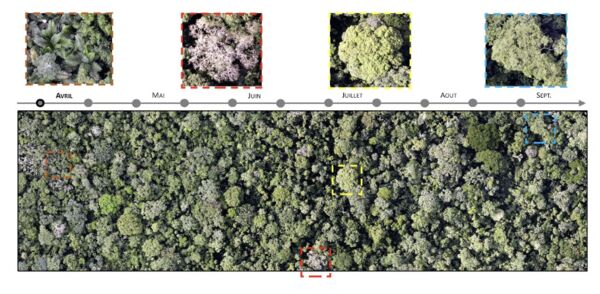
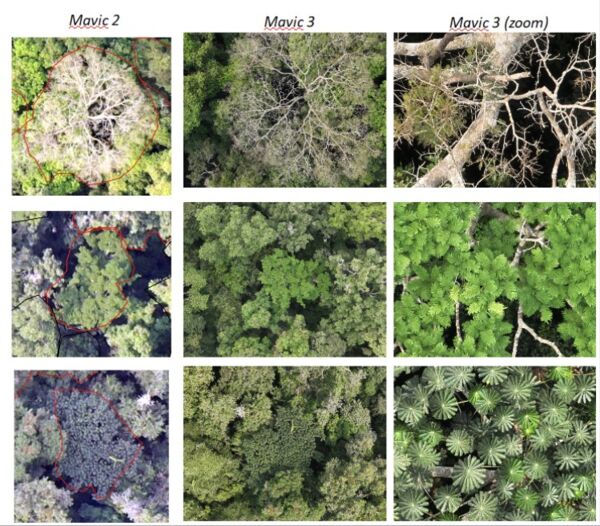
The Mbalmayo site is also part of the canobs.net network, which combines RGB and LiDAR drone observations to monitor canopy dynamics and seasonal variations in vegetation. Under the supervision of Pierre Ploton and Nicolas Barbier (IRD-AMAP), staff from ENEF and the National Cartographic Institute (Imma Tcheferi) have been conducting fortnightly flights over the site for several years, thereby building up a unique dataset to track seasonal changes tree by tree across hundreds of hectares. In parallel with the structural measurements, several complementary studies have been carried out:
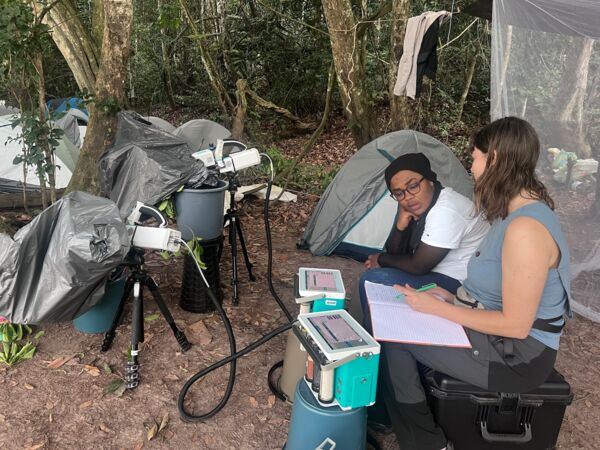
Ecophysiological measurements of leaves as part of the Coforfunc project. In particular, Australian postdoctoral researcher Kali Middelby studied the effect of leaf ageing on their physiological properties and their response to temperature.
Measurements of functional traits and properties related to water stress across numerous species.
Detailed soil analyses, conducted by Gilles Dauby and David Bauman (AMAP), to understand spatial variations in edaphic properties and their influence on stand dynamics (tree growth and survival).
Dynamics of these stands (monitoring of mortality and growth of over 9,500 trees distributed across contrasting forest types, ranging from periodically flooded forests with flood depths of up to 2.5 m to the famous forests dominated by Limbali (Gilbertiodendron dewevrei), whose functioning and dynamics remain a mystery).
Dynamics of trees in the understorey, with the establishment of permanent monitoring plots in 20 m by 20 m quadrats for trees with breast-height diameters between 2 and 10 cm, thereby enabling the documentation of these often-neglected forest strata where both emerging canopy species (regeneration) and undergrowth species rarely or even never found in conventional plots.
These measurements of biological characteristics and forest inventories will be fed into the Cafriplot.net database, which aims to improve the management and consistency of botanical data in Central Africa, using tools that all partners can adopt.
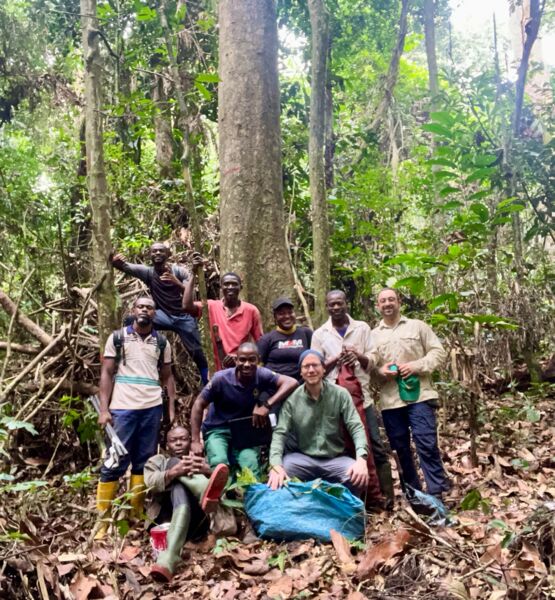
These detailed ecological surveys are made possible thanks to the work of a team of experienced climbers trained over many years by IRD-AMAP, comprising ENEF eco-guards and members of local communities, including the exceptional ‘Tonton Alex’ from Kompia.
The project also involved several Cameroonian students from the University of Yaoundé I and the ENS in Professor Bonaventure Sonké’s LaboSystE laboratory. Among them were Aicha Mfout Vessah — already known to the OFVI community following her interview last year — and Fabrice Nzoyeuem Djonko, a PhD student holding an IRD ARTS grant who is studying the effect of flood gradients and topography on the composition of plant communities. Thanks to measurements from the Mbalmayo observatory, Ninon Besson (an OFVI PhD student) is also able to conduct her research into the architecture and functioning of trees, whilst Colonel Danièle Bikie Mindang is preparing to defend her Master’s thesis in plant biology.
This research benefits from the support of numerous Cameroonian partners, notably the ENEF in Mbalmayo and its director Germain Mbock, as well as the Ministry of Forests and Wildlife (MINFOF) and the Ministry of Research and Higher Education (MINRESI).
A natural laboratory facing environmental pressures
The Mbalmayo site also provides an ideal setting for analysing the pressures exerted on tropical forests near urban centres: agricultural expansion, sand extraction from the riverbed, illegal logging and slash-and-burn farming.
The presence of Georges Eyenga, a sociologist of science from the University of Dschang, during the mission also enabled the social and institutional dimensions of the collaborative research to be explored.
Next steps
The data collected during this mission will now be analysed to quantify variations in tree growth more accurately and to improve models linking tree structure, biodiversity and carbon dynamics in tropical forests.
This work contributes to OFVI’s goal of better understanding and monitoring the functioning of tropical forests in order to inform conservation policies and the fight against climate change.
It will also enable the calibration of satellite-based approaches and climate-vegetation models, in order to extrapolate these observations to a larger scale and better anticipate the effects of climate change.
Finally, this type of observatory fosters collaboration with other disciplines, notably Earth and water sciences, to establish water and biogeochemical balances at the catchment scale, and social sciences, to better understand the impact of forest resource management and use practices.
By browsing our site you accept the installation and use cookies on your computer.
Know more
Our use of cookies
Cookies are a set of data stored on a user’s device when the user browses a web site. The data is in a file containing an ID number, the name of the server which deposited it and, in some cases, an expiry date. We use cookies to record information about your visit, language of preference, and other parameters on the site in order to optimise your next visit and make the site even more useful to you.
To improve your experience, we use cookies to store certain browsing information and provide secure navigation, and to collect statistics with a view to improve the site’s features. For a complete list of the cookies we use, download “Ghostery”, a free plug-in for browsers which can detect, and, in some cases, block cookies.
You can also visit the CNIL web site for instructions on how to configure your browser to manage cookie storage on your device.
In the case of third-party advertising cookies, you can also visit the following site: https://www.youronlinechoices.com/fr/controler-ses-cookies/, offered by digital advertising professionals within the European Digital Advertising Alliance (EDAA). From the site, you can deny or accept the cookies used by advertising professionals who are members.
It is also possible to block certain third-party cookies directly via publishers:
Cookie type
Means of blocking
Analytical and performance cookies
Realytics Google Analytics Spoteffects Optimizely
Targeted advertising cookies
DoubleClick Mediarithmics
The following types of cookies may be used on our websites:
Mandatory cookies
Functional cookies
Social media and advertising cookies
These cookies are needed to ensure the proper functioning of the site and cannot be disabled. They help ensure a secure connection and the basic availability of our website.
These cookies allow us to analyse site use in order to measure and optimise performance. They allow us to store your sign-in information and display the different components of our website in a more coherent way.
These cookies are used by advertising agencies such as Google and by social media sites such as LinkedIn and Facebook. Among other things, they allow pages to be shared on social media, the posting of comments, and the publication (on our site or elsewhere) of ads that reflect your centres of interest.
Our EZPublish content management system (CMS) uses CAS and PHP session cookies and the New Relic cookie for monitoring purposes (IP, response times). These cookies are deleted at the end of the browsing session (when you log off or close your browser window)
Our EZPublish content management system (CMS) uses the XiTi cookie to measure traffic. Our service provider is AT Internet. This company stores data (IPs, date and time of access, length of the visit and pages viewed) for six months
Our EZPublish content management system (CMS) does not use this type of cookie.
For more information about the cookies we use, contact INRAE’s Data Protection Officer by email at cil-dpo@inra.fr or by post at:
INRAE 24, chemin de Borde Rouge –Auzeville – CS52627 31326 Castanet Tolosan cedex - France