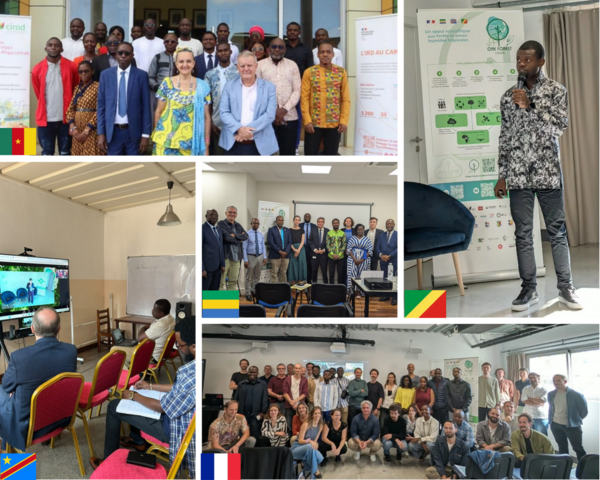
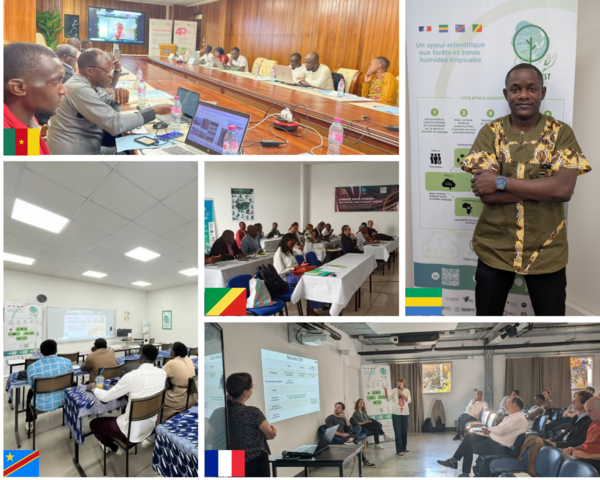
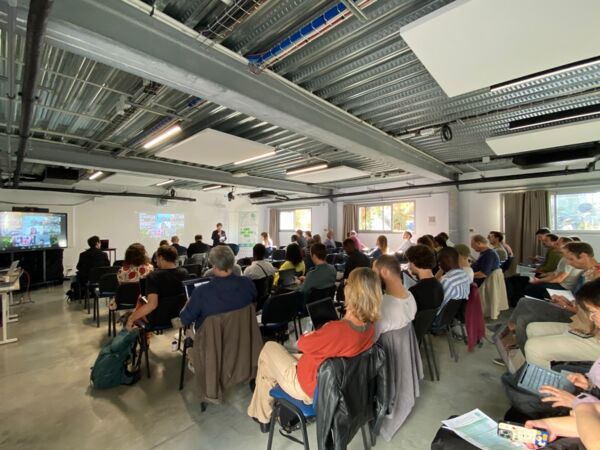
On 14 and 15 October 2026, the One Forest Vision (OFVi) initiative brought together 150 participants in person, spread across six venues in Brazzaville, Kinshasa, Libreville, Lubumbashi, Marseille and Yaoundé, along with around 100 webinar participants. Over the course of two days, researchers, PhD students, institutional representatives and scientific partners shared the latest research findings on the tropical forests and wetlands of the Congo Basin, three years after the initiative was launched.
Yaoundé (Cameroon) – 30 participants gathered at COMIFAC headquarters, in the presence of the IRD’s regional representative and the CIRAD’s regional representative.
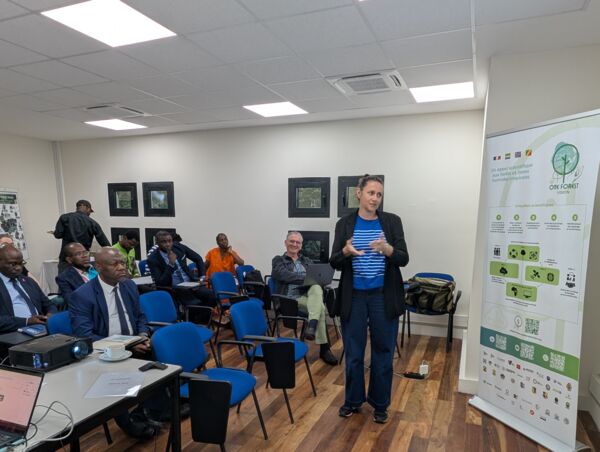
Libreville (Gabon) – 20 participants gathered at the French Institute of Gabon, in the presence of the Cooperation and Cultural Action Adviser (COCAC) from the French Embassy.
Brazzaville (Republic of the Congo) – Abel Mouyabi, an OFVi PhD student, presented his field research carried out in the Congo to the audience gathered in Marseille and the 20 participants joining via video link from Brazzaville.
Lubumbashi and Kinshasa (DRC) – 10 scientists gathered at the French Institute in Lubumbashi and 15 participants in Kinshasa followed the discussions via a multi-site link.
Marseille (France) – 55 participants gathered at the Friche la Belle de Mai, including researchers, PhD students, supervisors and representatives from the field of scientific diplomacy, as well as around a hundred additional participants joining the webinar online.
A scientific collaboration between the Congo Basin and France
Organised for the third consecutive year, the annual OFVi seminar brought together the scientific community and its partners from five countries: Gabon, Cameroon, the Republic of the Congo, the Democratic Republic of the Congo and France.
Thanks to a multi-site system linking six locations simultaneously, speakers were able to present their work and engage in live discussions, despite the geographical distances. A webinar also enabled a wider audience to follow the presentations remotely. This third edition provided a key opportunity to take collective stock of the activities carried out since 2023, highlight collaborations between partner institutions and identify future scientific priorities.
Yaoundé (Cameroon) – Live coverage of the seminar from COMIFAC headquarters, linked to other venues via a multiplex feed.
Libreville (Gabon) – Carmel Mounziegou presents her PhD research from the French Institute of Gabon.
Kinshasa / Lubumbashi (DRC) – Scientific teams gathered at the French Embassy in Kinshasa are taking part in the discussions via a multi-site link.
Brazzaville (Republic of the Congo) – Researchers and scientific partners are following the presentations and taking part in the discussions remotely.
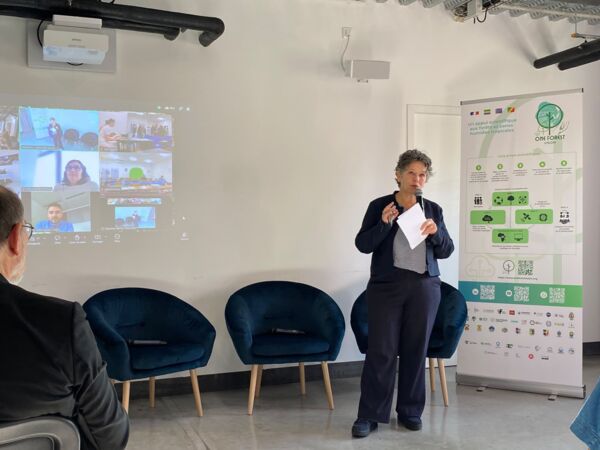
Marseille (France) – Sabrina Krief is speaking live from Marseille, alongside participants connected from various countries in the Congo Basin.
Two days to take stock and share scientific progress
The first day, 14 October, began with an institutional session bringing together representatives from the main French research organisations and ministries partnering with OFVi. Their speeches highlighted the importance of scientific cooperation between France and the countries of the Congo Basin, as well as the collective commitment to the initiative.
Speakers at the official opening included:
Valérie Verdier, Chair and Chief Executive of the IRD.
Marjolaine Chiriaco, Head of the ‘Environment, Earth and Universe Sciences’ department at the Directorate-General for Research and Innovation (DGRI) of the Ministry of Higher Education, Research and Space.
Marc Sitter, Head of the Biodiversity and Ecosystems Division at the Ministry for Europe and Foreign Affairs.
Thierry Caquet, Vice-President for International Affairs at INRAE and co-coordinator of the One Forest Vision initiative, who praised the commitment and dedication of the scientific teams and partners.
Following this opening session, discussions provided an opportunity to take stock of scientific and institutional achievements in the partner countries, before addressing several cross-cutting issues: data sharing and utilisation, the training of young researchers, capacity building and scientific co-creation.
The second day, 15 October, highlighted OFVi’s scientific findings across four main themes:
Forest carbon and biodiversity, from the field to the landscape scale;
Remote sensing and artificial intelligence applied to the study of tropical forests;
The integration of the humanities and social sciences;
The carbon balance of tropical forests at the largest scales.
These presentations provided context for the work carried out by African and French scientific teams, whilst fostering exchanges between disciplines, institutions and generations of researchers. The detailed programme is available on the One Forest Vision website.
Deployment and dissemination of the automated species monitoring tool: i) using camera traps for 64 prediction classes with 86 per cent accuracy in tropical regions (DeepForestVision V2) and ii) using passive acoustic recorders for 12 prediction classes with over 85 per cent accuracy (DeepForestSound V1)
Development of open-source code to measure canopy height on a global scale using LiDAR data (lidR/lasR from GCA), as well as an R library called BIOMASS enabling the prediction of biomass maps.
Currently, 77 per cent of the flora of Central-West Tropical Africa has been documented (compared with 22 per cent at the start of the initiative), 40 per cent of which is still based solely on herbarium scans.
Production of annual (2019–2023) high-resolution maps of canopy height (10 m) and biomass (30 m) for the forests of Central Africa.
Presentation of the long-term spread of disturbances from 1991 to 2020, with cumulative losses of AGC of −820 ± 100 Tg C. More than 70 per cent of these losses occur within 1 km of forests already disturbed in 1990, mainly due to agricultural expansion and fires.
A Cumulative Sum of Residuals (CuSum) radar-based forest disturbance monitoring system covering intertropical Africa from 2014 to 2025
Measuring the extent of water bodies in seasonal floodplains using radar textures with the Radar Inundation from Signal Evolution (RISE) method: production of land-cover maps (Sentinel-1 only, every 12 days) and maps of water surface extent (Sentinel-1 and PALSAR-2, every 1.5 months)
Archaeobotanical data increasingly suggest that the forests of Central Africa are the result of long-term interactions between animals and humans - Plants, calling into question the notion of a ‘virgin’ forest (traces of human presence dating back millennia) and prompting a re-evaluation of human exceptionalism (one animal species amongst many others that contributes to ecosystem dynamics).
Three years on from the One Forest Summit: a scientific momentum that continues
Launched as a follow-up to the One Forest Summit held in Libreville in March 2023, the One Forest Vision initiative continues to pursue its aim of strengthening scientific knowledge of the tropical forests and wetlands of the Congo Basin, whilst developing research capacity and collaborations with institutions in partner countries.
This third annual seminar provides an opportunity to highlight the scientific progress made over the past three years and to outline future prospects for cooperation.
The One Forest Vision 2026 seminar: key figures
Nearly 250 participants, including 150 attending in person and around 100 joining the webinar.
5 countries involved: Gabon, Cameroon, the Republic of the Congo, the Democratic Republic of the Congo and France.
6 locations connected via a multi-site link: Libreville, Yaoundé, Brazzaville, Kinshasa, Lubumbashi and Marseille.
Around twenty scientific, academic and diplomatic institutions were represented.
Two days of scientific discussions centred on the initiative’s five pillars of research.
17 scientific articles published over three years, the main findings of which were presented and put into context during the seminar.
By browsing our site you accept the installation and use cookies on your computer.
Know more
Our use of cookies
Cookies are a set of data stored on a user’s device when the user browses a web site. The data is in a file containing an ID number, the name of the server which deposited it and, in some cases, an expiry date. We use cookies to record information about your visit, language of preference, and other parameters on the site in order to optimise your next visit and make the site even more useful to you.
To improve your experience, we use cookies to store certain browsing information and provide secure navigation, and to collect statistics with a view to improve the site’s features. For a complete list of the cookies we use, download “Ghostery”, a free plug-in for browsers which can detect, and, in some cases, block cookies.
You can also visit the CNIL web site for instructions on how to configure your browser to manage cookie storage on your device.
In the case of third-party advertising cookies, you can also visit the following site: https://www.youronlinechoices.com/fr/controler-ses-cookies/, offered by digital advertising professionals within the European Digital Advertising Alliance (EDAA). From the site, you can deny or accept the cookies used by advertising professionals who are members.
It is also possible to block certain third-party cookies directly via publishers:
Cookie type
Means of blocking
Analytical and performance cookies
Realytics Google Analytics Spoteffects Optimizely
Targeted advertising cookies
DoubleClick Mediarithmics
The following types of cookies may be used on our websites:
Mandatory cookies
Functional cookies
Social media and advertising cookies
These cookies are needed to ensure the proper functioning of the site and cannot be disabled. They help ensure a secure connection and the basic availability of our website.
These cookies allow us to analyse site use in order to measure and optimise performance. They allow us to store your sign-in information and display the different components of our website in a more coherent way.
These cookies are used by advertising agencies such as Google and by social media sites such as LinkedIn and Facebook. Among other things, they allow pages to be shared on social media, the posting of comments, and the publication (on our site or elsewhere) of ads that reflect your centres of interest.
Our EZPublish content management system (CMS) uses CAS and PHP session cookies and the New Relic cookie for monitoring purposes (IP, response times). These cookies are deleted at the end of the browsing session (when you log off or close your browser window)
Our EZPublish content management system (CMS) uses the XiTi cookie to measure traffic. Our service provider is AT Internet. This company stores data (IPs, date and time of access, length of the visit and pages viewed) for six months
Our EZPublish content management system (CMS) does not use this type of cookie.
For more information about the cookies we use, contact INRAE’s Data Protection Officer by email at cil-dpo@inra.fr or by post at:
INRAE 24, chemin de Borde Rouge –Auzeville – CS52627 31326 Castanet Tolosan cedex - France